


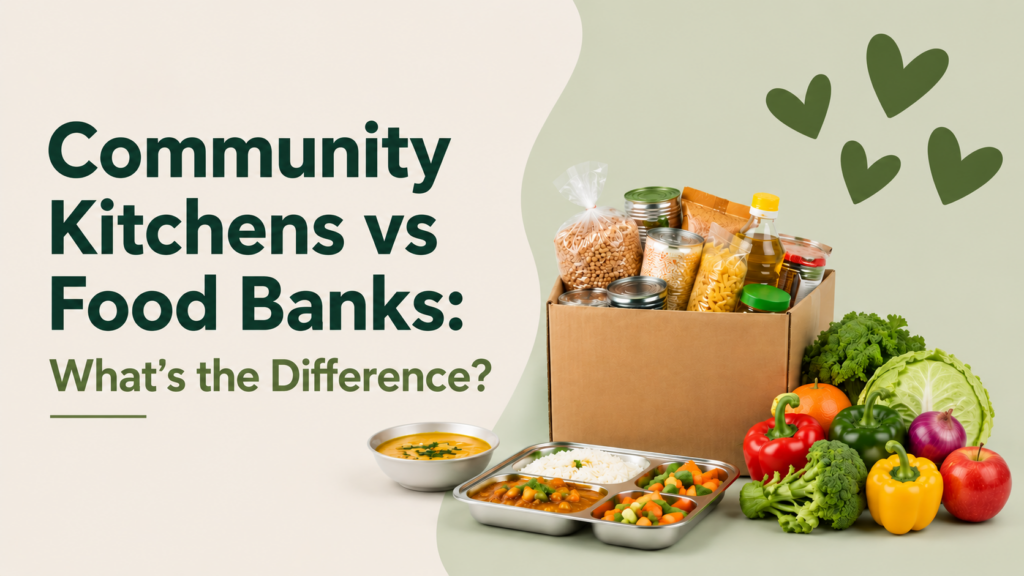
When people want to help reduce hunger, two terms often come up: community kitchens and food banks. Both support people facing food insecurity, but they do not operate in exactly the same way. A community kitchen usually turns ingredients into fresh, ready-to-eat meals. A food bank, on the other hand, collects, stores, and distributes food supplies such as rice, flour, pulses, canned goods, and other groceries. So, what is the difference between a community kitchen vs food bank, and which one should you support? The answer depends on the type of help a community needs. Understanding how each model works can help donors and volunteers choose where their contribution can make the greatest difference.
Community Kitchen vs Food Bank: Quick Difference
The simplest way to understand the difference is:-
- Community kitchen:- Prepares and serves cooked meals.
- Food bank:- Collects, stores, and distributes food supplies.
A community kitchen is generally designed for immediate meal support, while a food bank can provide groceries that families or partner organizations can use over several days. Both approaches can reduce hunger, but they solve different parts of the food-access problem.
What Is a Community Kitchen?
- Low-income families
- Children and students
- Older adults
- People experiencing homelessness
- Daily-wage workers
- Communities affected by emergencies
- People experiencing food insecurity
How Does a Community Kitchen Work?
A typical community kitchen may follow a simple process:-
- Food ingredients are purchased or donated.
- Staff and volunteers prepare the ingredients.
- Meals are cooked.
- Food is packed or served.
- Meals are distributed to people who need them.
Some kitchens operate every day, while others run on particular days or as part of emergency or community-support programs.
What Is a Food Bank?
A food bank is an organization or facility that collects, stores, sorts, and distributes food to individuals, families, charities, shelters, schools, and other community organizations. Unlike a community kitchen, a traditional food bank does not primarily focus on cooking meals. Its main role is to make food supplies available where they are needed. Food banks may receive donations from:-
- Individuals
- Grocery stores
- Food manufacturers
- Restaurants
- Farmers
- Businesses
- Community food drives
- Nonprofit or institutional partners
The food may include rice, wheat, flour, pulses, canned foods, cereals, fresh produce, packaged staples, and other suitable groceries. This model can be particularly useful for households that have a place to cook but need help accessing affordable food.
Community Kitchens vs Food Banks: Main Difference
The biggest difference between a community kitchen and food bank is what happens to the food. A community kitchen generally uses ingredients to prepare meals. A food bank generally stores and distributes food supplies. For example, if a business donates 100 kilograms of rice, a food bank may distribute that rice to families or community organizations. A community kitchen may combine the rice with vegetables, pulses, and other ingredients to prepare meals.
| Community Kitchens | Food Banks |
|---|---|
| Prepare and serve meals | Collect and distribute food |
| Focus on ready-to-eat meals | Focus on groceries and food supplies |
| Often serve people directly | May distribute through partner organizations |
| Need cooking facilities | Need storage and distribution facilities |
| Provide immediate meal support | Provide household food support |
| Volunteers may cook and serve | Volunteers may sort, pack, and distribute |
In simple terms, community kitchens provide meals, while food banks provide food supplies.
How Are Community Kitchens and Food Banks Similar?
Although their operations differ, both have the broader goal of reducing hunger and improving access to food.
Both may:-
- Support vulnerable communities
- Reduce food insecurity
- Depend on donations
- Rely on volunteers
- Work with nonprofit organizations
- Respond to local needs
- Help reduce suitable food waste
- Connect people with essential resources
In some cases, they can work together. A food bank may supply ingredients to a community kitchen, which then transforms those ingredients into prepared meals.
Why Are Community Kitchens Important?
- Natural disasters
- Economic hardship
- Homelessness
- Community emergencies
- Temporary displacement
- Local food shortages
Why Are Food Banks Important?
- Rice
- Wheat and flour
- Pulses
- Canned foods
- Cereals
- Cooking ingredients
- Fruits and vegetables
- Other essential groceries
Which One Helps More?
There is no universal answer to community kitchen vs food bank. A community kitchen may be more appropriate when people need immediate, ready-to-eat meals. A food bank may be more useful when families need groceries to take home and prepare. The best option depends on local needs, available facilities, volunteers, funding, and the organization’s goals. In many communities, the strongest approach may be to support both.
Community Kitchens and Food Banks in India
In India, food-relief programs can take different forms depending on the needs of local communities. NGOs, charitable organizations, community groups, and volunteers may provide cooked meals, ration kits, food donations, or emergency assistance. A large urban community may have different needs from a rural area. Similarly, an organization focused on immediate meal support may operate differently from one providing household groceries. For donors in India, it is therefore important to understand what an organization actually does before donating.
What Should You Check Before Supporting an NGO?
Before contributing to a food-relief organization, look for clear information about:-
- What type of food support it provides
- Who benefits from the program
- Where its activities take place
- How donations are used
- What volunteer opportunities are available
- Whether it reports its activities
- How donations can be made
These checks can help donors make informed decisions and choose organizations that clearly communicate their work.
What Should You Donate?
The right donation depends on the organization.
A community kitchen may need:-
- Rice
- Pulses
- Flour
- Cooking oil
- Vegetables
- Spices
- Packaged food
- Kitchen supplies
- Financial contributions
A food bank may request:-
- Rice
- Flour
- Pulses
- Cereals
- Canned foods
- Packaged staples
- Long-life food products
- Other household groceries
Always ask the organization what it needs before donating. Some organizations may have specific requirements for packaging, expiry dates, storage, or perishable food.
Is Donating Money Better Than Donating Food?
How Can You Volunteer?
Volunteering is another practical way to support hunger-relief programs. At a community kitchen, volunteers may help with:-
- Preparing ingredients
- Cooking
- Packing meals
- Serving food
- Cleaning
- Organizing supplies
At a food bank, volunteers may assist with:-
- Sorting donations
- Checking food items
- Packing food boxes
- Managing inventory
- Loading supplies
- Supporting distribution events
Even a few hours of regular volunteering can help an organization operate more efficiently.
Can One Organization Run Both?
Yes. An organization can operate both a food bank and community kitchen if it has the necessary resources and facilities.
For example:-
Cooked meals → Immediate food assistance
Grocery distribution → Household food assistance
This combined approach can help an organization respond to different needs within the same community. The important question is not simply, “Which one is better?” Instead, ask:
“What type of food support is most needed by this community right now?”
How You Can Help Fight Hunger
You do not need to make a huge contribution to help.
You can:-
- Donate food
- Make a financial contribution
- Volunteer your time
- Organize a local food drive
- Support a community kitchen
- Support a food bank
- Encourage businesses to donate suitable surplus food
- Share information about local food programs
Small contributions can become much more meaningful when individuals, businesses, NGOs, and volunteers work together.
Final Thoughts
The main difference between community kitchens vs food banks is how food reaches people. A community kitchen focuses on preparing and serving meals, while a food bank focuses on collecting, storing, and distributing food supplies. Neither model is automatically better. Each serves a different purpose, and in many communities, they can complement one another. If you want to donate or volunteer, start by understanding the organization’s actual needs. A targeted donation, useful volunteer support, or financial contribution can often be more valuable than simply giving whatever is available. When communities work together, food resources can become meaningful support for people and families facing food insecurity.